The clock shop was infused with the scent of brass and lemon oil, each cabinet housing the ticking hands of history.
It was the sort of autumn morning when the fog hugged the cobbles like a sleepy cat. Emma pushed open the bell on Mr Calder’s workshop, and the small bell gave a tired ting, like a secret clearing its throat. Inside, glass faces and brass gears shone; a great old clock stood silent in the centre, its face clouded and its pendulum still.
Mr Calder, a kind clockmaker whose fingers remembered every tiny gear, looked up. “Someone’s been here,” he said. “My master clock has stopped, and my special weight is gone.” His voice was like an old metronome, steady, worried. The children’s detective instincts sparked. A mystery had begun.
The master clock kept town time. It was wound by a heavy lead weight that fell slowly, keeping the gears moving. Mr Calder explained that the missing weight was not important for its heft alone. Fixed to its side had been a thin brass plaque, engraved with a coded sequence of numbers – the very code that kept the master clock wound to perfection. That clock, in turn, sent out a faint electromagnetic pulse each hour, nudging other clocks in the city to stay true. Without the plaque, the winding schedule faltered, and the city’s time began to drift like ripples across a pond.
“Someone may have thought the weights were worth something as scrap metal,” Calder murmured, “or perhaps they mistook the plaque for a piece of gold. Either way, they never realised that the smallest part was the most precious, the heartbeat that kept the whole city in step.”
 Amira ran her fingers along the empty hook where the weight had hung, feeling the chill of its absence. Her mind worked with quiet precision, sifting through the options until a hidden pattern began to emerge. With a sharp glance at the others, she signalled that it was time to begin.
They found scuff marks on the back door, a smear of oil on the threshold, and a series of tiny numbers scratched on the inside of a drawer: 54, 36, 18. Lucy frowned. “It’s a puzzle in numbers and movement,” she said. “Someone who knows clocks did this.”
At the heart of the puzzle were gears, swings, faces and missing things. The children divided tasks. Oliver inspected gear patterns, Emma mapped the winding rope, Jack checked weights, while Amira did the thinking that turned loose ends into leads.

The great clock loomed above them like a golden giant, ticking softly in the shadows. Behind its glass face was a maze of brass gears, each one turning, clicking, and whispering as if sharing a secret.
Gear A was the largest, its rim studded with 54 shining teeth. Every tooth caught the light like a spark as it moved. Gear A turned two full rotations every minute, steady and smooth, the heartbeat of the clock itself.
Right beside it, Gear B looked tiny in comparison. It had only 18 teeth, but it was fierce and fast. Each time Gear A turned once, its teeth pushed against Gear B’s, forcing it to spin in the opposite direction. Because Gear B was smaller, it had to work harder, spinning three times for every single turn of the big gear.
The gears glimmered like a living machine, big and small working together, slow and fast, strong and quick. The air hummed with rhythm: click, whirr, click, whirr. The sound was steady, almost musical, like a secret code of time itself.
“The small wheel turns because the big one moves it,” whispered Lucy, her eyes wide.
Jack nodded slowly. “And if even one tooth is missing,” he said, glancing up at the clock’s trembling hands, “the whole rhythm breaks.”
They exchanged a look. Maybe the answer to the mystery wasn’t hidden in the clock’s face at all, but in something that wasn’t turning the way it should.
❌ Focus on how many teeth pass the contact point each minute. In this situation, the saying “tooth for tooth” really does apply – quite literally!
Oliver:“Calculate total teeth passing the contact point each minute.”
Step 1: Gear A has 54 teeth and turns 2 full rotations per minute (54 × 2 = 108 teeth per minute).
Step 2: Gear B turns in direct contact with Gear A, meaning the exact same number of teeth must pass through each minute (108 teeth).
Step 3: Divide 108 teeth by Gear B’s 18 teeth to find how many rotations Gear B makes per minute.
Jack:“Use the ratio of teeth between the two gears.”
Find the gear ratio first: 54 divided by 18 = 3. This means Gear B turns 3 times for every single turn of Gear A. Multiply 3 by Gear A’s 2 rotations per minute (3 × 2 = 6 rotations).
✅ Well done!
The clock’s pendulum had once swung with the regularity of a steady heartbeat, its motion a gentle whoosh that seemed to whisper time itself.

Mr Calder explained that when the master clock was working properly, the pendulum swung 180 times in 15 minutes, each swing marking the passing time like tiny footsteps echoing through the quiet workshop. Emma and the others watched in fascination, mesmerised by the rhythm, which felt almost alive. A silver thread weaving the present into the past, keeping the city’s hours in perfect synchrony.
❌ Start by working out how many swings occur in one minute.
Lucy:“Work out the rate for just 1 minute first!”
Step 1: Divide 180 swings by 15 minutes to find out how many times the pendulum swings in 1 minute.
Step 2: Take your 1-minute total and multiply it by 8 to find the swings in 8 minutes!
Emma:“Set up a direct ratio to scale your numbers!”
Step 1: Think of the relationship: Swings ÷ Minutes. Write it down as 180 over 15.
Step 2: Simplify this fraction by dividing both top and bottom by 15 to get your unit rate (swings per 1 minute).
Step 3: Multiply your simplified rate by 8 minutes to reach the target duration!
✅ Exactly! The pendulum is like a heartbeat: steady, steady.
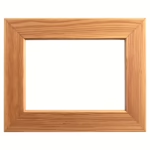
A smaller, beautifully decorated clock stood proudly inside a sturdy rectangular wooden case, measuring 40 cm in length and 30 cm in width. Nestled within this case was a decorative inner panel, the very stage where the clock’s ornate dial performed its silent ballet of numbers.

This panel was inset neatly from the edges, leaving a polished wooden frame all around, 5 cm wide on every side. The frame’s rich grain caught the light, glinting like tiny rivers of gold, and seemed to hug the dial as if protecting its secrets.
The children realised that to measure the wooden frame itself, they would need to think carefully about the space it covered.
|
❌ You only need to calculate the area of the front of the frame. Think of it as two rectangles: a large outer rectangle (the whole case) and a smaller rectangle (the dial panel) placed inside it. The wooden frame is the part of the larger rectangle that is not covered by the smaller rectangle.
|
|
Amira:“Think of the frame like a picture frame. The wooden part is just whatever is left over!”
Step 1: Find the area of the entire outer rectangle using its full length and width.
Step 2: Calculate the dimensions of the inner panel. Careful! Remember to double-subtract the border width (once for each side)!
Step 3: Subtract the inner area from the total outer area to leave just the frame.
Oliver:“I prefer splitting the border into smaller, bite-sized rectangles!”
Top & Bottom: Picture two full-width horizontal strips running along the top and bottom edge.
Left & Right: Find the height of the two remaining vertical side strips tucked in between them.
Calculate the area of all 4 pieces and add them together!
✅ That’s correct! The clockmaker would hire you on the spot!
The children peered into the inside drawer of the master clock. Along the worn wood, a curious sequence of numbers was scratched: 3, 6, 11, 18, ?. It looked almost like a secret code left by someone in a hurry. Oliver traced the numbers with his finger. “These aren’t random,” he said. “Each number seems to grow from the last, but not by the same amount. Maybe it’s a pattern in how much they increase each time.”

❌ That doesn’t fit the pattern.
Jack:“The jumps between the terms aren’t staying the same. Find the pattern in the increases!”
Step 1: Work out how much the sequence increases from term to term: 3 ➔ 6, 6 ➔ 11, and 11 ➔ 18.
Step 2: Look closely at those difference numbers (+3, +5, +7…). What kind of numbers are they?
Step 3: Continue that pattern to find the next jump, then add it to 18!
Lucy:“I spotted a shortcut using special square numbers!”
Step 1: List the first few square numbers 1 times 1, 2 times 2, 3 times 3, 4 times 4, 5 times 5…).
Step 2: Compare each square number to the terms in the code (3, 6, 11, 18…). Notice what has been added to each square!
Step 3: Apply that exact same rule to the 5th square number (5 times 5).
✅ That fits the pattern!
The master clock wound itself using a heavy lead weight, which descended slowly, like a tiny sun sinking in the sky.

When the clock was correctly wound, the weight dropped 5 millimetres every 15 minutes, its steady journey keeping the pendulum swinging and the gears ticking in perfect harmony.
To keep the clock running smoothly until the next winding, the weight needed to descend a total of 72 cm. The children realised that calculating how long it would take for the weight to reach the bottom was a puzzle in itself, a race against time, measured in centimetres and minutes, hidden within the rhythm of the falling weight.
❌ Try dividing distance by speed (cm ÷ cm per hour).
Amira:“Find how far it drops in 1 full hour first. This saves you so many calculations!”
Step 1: There are four 15-minute blocks in 1 hour. Multiply 5 mm by 4 to find the hourly drop in millimetres.
Step 2: Convert that hourly drop into centimetres (10 mm = 1 cm).
Step 3: Divide the total distance (72 cm) by your hourly drop in centimetres to find the total hours!
Emma:“Before dividing, make sure your distance units match!”
Step 1: Convert the total descent distance (72 cm) into millimetres (1 cm = 10 mm).
Step 2: Divide that total millimetres by 5 mm to see how many 15-minute intervals it takes.
Step 3: Multiply the intervals by 15 to get the total time in minutes, then divide by 60 to convert to hours!
✅ Perfect! That should give the clockmaker enough time to repair the clock.
While checking the weights, Jack noticed footprints leading to the back lane where the cobbles glinted. Beneath a puddle lay a thin strip of brass – not the weight itself, but the brass plaque with a coded set of numbers it once carried.

Oliver traced the footprints. “They head toward the market, then vanish. The thief must have panicked and dropped it.”
Emma frowned. “Or perhaps they thought it was gold, and when they realised it wasn’t, they ditched it and fled.”
Mr Calder fixed the weights back onto the master clock and pressed the brass plaque into place, tracing the engraved code with a steady hand. The pendulum shivered, then swung into motion. Slow, sure, and steady as breath returning after a long silence. Calder’s lined face softened into a smile.

“We hunt for grand causes,” he said gently, “yet it is the tiniest pieces that keep the world in rhythm.”
Emma whispered, almost to herself, “A tiny clue solved the biggest puzzle.” Oliver nodded, his eyes following the pendulum’s swing. “And without it, the whole city would have lost its heartbeat.”
Case Closed